
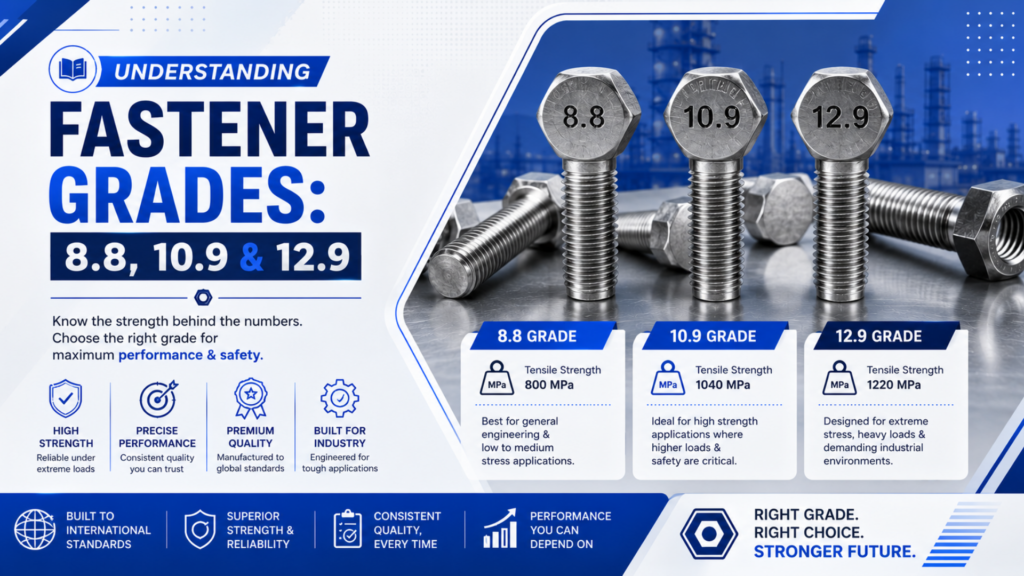
If you have purchased metric bolts, you have probably seen markings such as *8.8, 10.9, or 12.9* on the bolt head or in a technical specification.
These numbers are not simply product names. They indicate the *property class* of a metric carbon or alloy steel fastener and provide information about its mechanical strength.
Understanding these markings is important when selecting fasteners for industrial and engineering applications.
What Does 8.8 Mean?
For a metric fastener marked *8.8*:
- The first number relates to the nominal tensile strength.
- The second number relates to the ratio between yield strength and tensile strength.
In simplified terms, an 8.8 fastener has a nominal tensile strength of approximately *800 MPa* and a nominal yield strength of approximately *640 MPa*.
8.8 is widely used for general engineering, machinery, automotive, construction, and industrial applications.
What Does 10.9 Mean?
A *10.9* property class indicates a higher strength level.
A 10.9 fastener has a nominal tensile strength of approximately *1,000 MPa* and a nominal yield strength of approximately *900 MPa*.
These fasteners are commonly considered for applications requiring higher mechanical strength.
What Does 12.9 Mean?
*12.9* represents an even higher property class.
It has a nominal tensile strength of approximately *1,200 MPa* and a nominal yield strength of approximately *1,080 MPa*.
12.9 fasteners are commonly used in demanding mechanical and engineering applications where high strength is required.
Comparison of 8.8, 10.9 & 12.9
| Property Class | Approx. Tensile Strength | Approx. Yield Strength | Typical Position |
| ————– | ———————–: | ———————: | —————————- |
| 8.8 | 800 MPa | 640 MPa | General engineering |
| 10.9 | 1,000 MPa | 900 MPa | Higher-strength applications |
| 12.9 | 1,200 MPa | 1,080 MPa | High-strength applications |
Values shown are nominal values associated with the property-class designation; applicable standards should be checked for exact requirements and product-size limitations.
Does a Higher Grade Always Mean a Better Fastener?
*No.*
A higher-strength fastener is not automatically the correct choice.
Fastener selection depends on:
- Joint design
- Loading
- Material compatibility
- Operating environment
- Temperature
- Corrosion
- Required preload
- Applicable standard
- Installation method
Using a fastener with an inappropriate strength level can create problems just as selecting one that is too weak can.
Why Is Correct Grade Important?
Consider a machinery assembly subject to significant loads and vibration.
Using a fastener with insufficient mechanical strength could result in:
- Fastener deformation
- Loosening
- Fatigue
- Joint movement
- Premature failure
On the other hand, simply upgrading to a higher property class without considering the complete joint design may not solve the underlying engineering issue.
How Are Fasteners Marked?
Many metric high-strength fasteners are marked on the head with their property class.
For example:
*8.8*
*10.9*
*12.9*
These markings allow users to identify the mechanical property class of the fastener.
However, markings should be considered alongside the applicable standard and product documentation.
What About Nuts?
The nut must also be suitable for the bolt being used.
A high-strength bolt should not simply be paired with an arbitrary standard nut. The nut specification, property class, dimensions, and compatibility should be checked as part of the complete joint.
Final Thoughts
Understanding fastener property classes helps engineers, procurement teams, contractors, and maintenance professionals make more informed purchasing decisions.
*8.8, 10.9, and 12.9* represent different levels of mechanical performance, but the correct choice depends on the specific application and applicable standard.
At *Rajputana Fasteners Trading LLC*, we understand the importance of supplying fasteners according to accurate technical specifications. From standard industrial requirements to specialized fastening needs, correct identification and specification are essential for dependable performance.
*Have a fastener requirement? Share your size, standard, grade, material, or drawing with our team for assistance.*