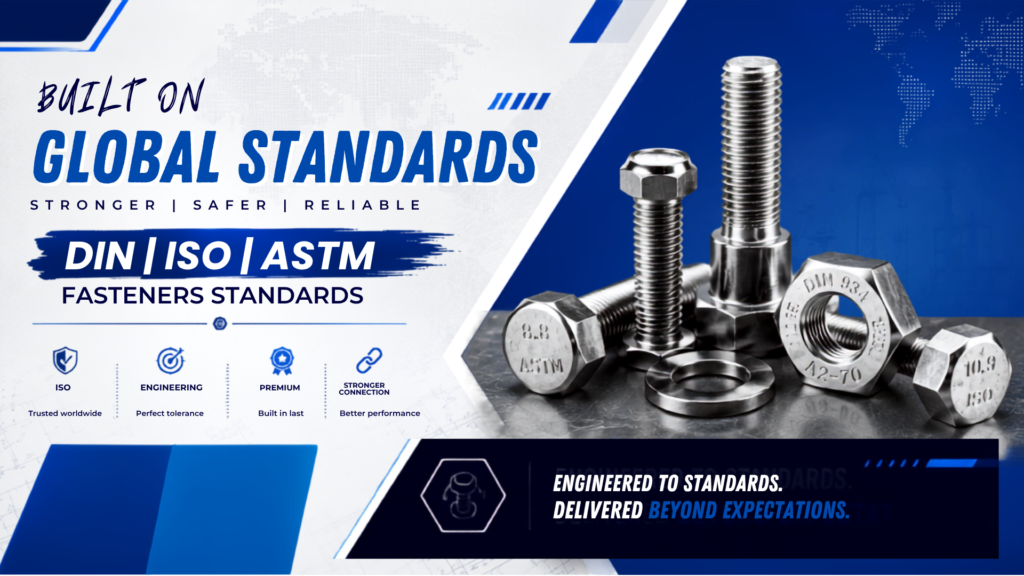
When purchasing industrial fasteners, terms such as *DIN, ISO, and ASTM* appear frequently on product specifications, drawings, quotations, and certificates. For buyers and engineers, understanding these standards is important because the standard can determine a fastener’s dimensions, material requirements, mechanical properties, testing methods, and performance.
Although DIN, ISO, and ASTM are all widely recognized, they are not interchangeable terms. Each represents a different standards system and may address different aspects of fastener manufacturing and testing.
What Are DIN Standards?
*DIN* stands for Deutsches Institut für Normung, the German Institute for Standardization.
DIN standards have traditionally been widely used for mechanical and industrial components, including bolts, nuts, washers, screws, and other fastening products.
Examples include specifications for:
- Hexagon bolts
- Hexagon nuts Washers
- Socket head cap screws
- Machine screws
- Various specialty fasteners
DIN standards are particularly common in European-designed machinery, engineering equipment, and industrial applications.
What Are ISO Standards?
*ISO* stands for International Organization for Standardization.
ISO standards are developed for international use and are designed to create greater consistency across different countries and industries.
For fasteners, ISO standards can specify:
- Dimensions
- Product types
- Tolerances
- Mechanical properties
- Material requirements
- Testing requirements
- Marking and identification
Many modern fastener specifications have transitioned from national standards toward internationally harmonized ISO standards.
What Are ASTM Standards?
*ASTM International*, formerly known as the American Society for Testing and Materials, develops standards covering materials, products, testing procedures, and performance requirements.
ASTM standards are extensively used in the United States and internationally, particularly in:
- Construction
- Oil & gas
- Petrochemical industries
- Structural applications
- Infrastructure
- Manufacturing
- Heavy engineering
ASTM fastener specifications often focus strongly on *material, mechanical performance, testing, and application requirements*.
DIN vs ISO vs ASTM
| Standard | Main Association | Common Use |
| ——– | ———————————————- | ————————————————————————————————- |
| DIN | German Institute for Standardization | European/German engineering |
| ISO | International Organization for Standardization | International applications |
| ASTM | ASTM International | Material and performance specifications, especially in North American and industrial applications |
The important point is that these standards can address *different characteristics of a fastener*. Therefore, simply matching the bolt diameter or thread size may not be enough.
Why Does the Standard Matter?
Selecting a fastener based only on its physical appearance can create serious problems.
Two fasteners may look almost identical but have different:
- Material compositions
- Strength levels
- Thread dimensions
- Tolerances
- Coatings
- Testing requirements
- Temperature capabilities
- Corrosion resistance
For critical applications, the correct standard should always be verified against the project specification or engineering drawing.
What Should Buyers Check?
Before ordering industrial fasteners, it is advisable to confirm:
- Fastener type
- Diameter and length
- Thread specification
- Material
- Property/class or grade
- Surface finish
- Applicable DIN, ISO, ASTM or other specification
- Required certificates
- Quantity
- Application requirements
Final Thoughts
DIN, ISO, and ASTM standards each play an important role in the fastener industry. The correct choice depends on the project, engineering requirements, applicable specifications, and customer requirements.
At *Rajputana Fasteners Trading LLC*, understanding technical specifications is an essential part of supplying industrial fastening solutions. Correct specification helps ensure reliability, compatibility, and consistent performance across construction, engineering, manufacturing, and industrial applications.
*Need help identifying the right fastener specification? Contact Rajputana Fasteners Trading LLC with your drawing, specification, or requirement.*