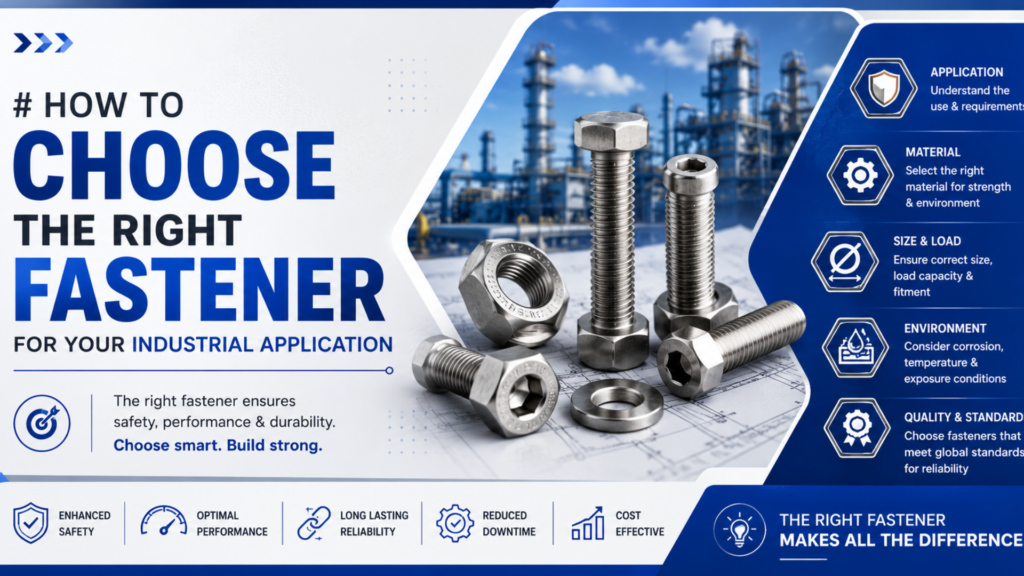
Choosing the correct fastener is much more than selecting a bolt that fits a hole. Industrial fasteners are responsible for holding components together under different loads, temperatures, environmental conditions, and operating stresses.
Selecting the wrong fastener can lead to corrosion, loosening, premature failure, equipment damage, and costly maintenance.
Here are the key factors to consider.
Understand the Application
Start by understanding where and how the fastener will be used.
Consider:
- Static or dynamic loading
- Indoor or outdoor installation
- Exposure to moisture
- Temperature
- Vibration
- Chemical exposure
- Structural requirements
- Installation method
A fastener suitable for indoor machinery may not be appropriate for a marine or outdoor environment.
Select the Correct Material
Fasteners are available in different materials, including:
- Carbon steel
- Stainless steel
- Alloy steel
- Brass
Other specialized materials
Material selection should depend on the required strength, corrosion resistance, temperature, and environmental conditions.
Consider Strength Requirements
Industrial applications can impose significant tensile, shear, and fatigue loads on fasteners.
For high-strength applications, property classes such as *8.8, 10.9, and 12.9* may be specified for metric fasteners.
However, higher strength does not automatically mean that a fastener is better for every application.
The fastener must be matched to the complete joint design.
Choose the Correct Thread
Thread compatibility is critical.
Important considerations include:
- Metric or imperial thread
- Thread diameter
- Pitch
- Coarse or fine thread
- Thread tolerance
- Nut compatibility
Using the wrong thread can result in poor engagement, cross-threading, or joint failure.
Select the Appropriate Surface Finish
Surface treatment can significantly affect corrosion resistance and service life.
Common finishes include:
- Zinc plating
- Hot-dip galvanizing
- Plain finish
- Various protective coatings
The appropriate finish depends on the environment and application.
Consider Corrosion
Corrosion is a major concern in industrial environments.
For applications exposed to:
- Humidity
- Saltwater
- Chemicals
- Outdoor conditions
- Coastal environments
a corrosion-resistant material or protective coating may be required.
In the UAE and wider GCC region, environmental exposure should be considered carefully when specifying fasteners for outdoor installations.
Check the Applicable Standard
Always verify the required standard before ordering.
Depending on the project, requirements may refer to:
- DIN
- ISO
- ASTM
- ASME
- BS
- Other project-specific specifications
The standard can determine dimensions, materials, mechanical properties, testing, and other requirements.
Check Certification Requirements
Certain projects require documentation such as:
- Material Test Certificates
- Certificates of Conformity
- Inspection documents
- Manufacturer documentation
- Test reports
These requirements should be confirmed before procurement.
Don’t Forget Washers and Nuts
A bolt should not be considered separately from the rest of the joint.
The complete fastening system may include:
*Bolt + Nut + Washer*
The nut and washer should be compatible with the bolt specification and application.
Fastener Selection Checklist
Before placing an order, confirm:
☑️ Type
☑️ Diameter
☑️ Length
☑️ Thread
☑️ Material
☑️ Grade/property class
☑️ Surface finish
☑️ Standard
☑️ Quantity
☑️ Certification requirements
☑️ Application/environment
Final Thoughts
Correct fastener selection contributes directly to the safety, durability, and reliability of an industrial assembly.
Whether you are sourcing fasteners for construction, machinery, fabrication, maintenance, or engineering projects, accurate specifications should always come first.
*Rajputana Fasteners Trading LLC* supplies industrial fastening products for a wide range of applications and can assist customers in identifying suitable products based on their technical requirements.